
Let’s just get it out of the way: I caved at launch.
In April, I smashed that pre-order button not once, but twice—one for me, and one for a friend. No hesitation. No regrets. My launch haul was Nintendo perfection: the Switch 2 bundle with Mario Kart, plus digital copies of Fantasy Life i and Bravely Default. I’ve also got my eyes locked on Pokémon Z-A in October—and am seriously debating Donkey Kong Bonanza (yes, I know the spelling’s off—because the game’s a grown-up beast I’m not tackling solo, but thank goodness for co-op with my husband).
This isn’t just a review. It’s a vibe check on Nintendo’s newest console. One part fan letter, one part grievance log, and entirely honest.
Performance & Visual Upgrades: Pokémon Violet Redemption Arc

Let’s be honest—on the original Switch, Pokémon Violet was a technical mess. Frame rate drops, pop-in so aggressive it felt like the world was assembling itself mid-sprint, and visuals that looked like someone smeared Vaseline on the screen and said, “It’s a vibe.” It wasn’t.
But on the Switch 2? It’s like Nintendo finally gave Violet a proper apology. The difference is immediately noticeable: the game boots up faster, the textures are crisper, and the open-world stutters that plagued the Paldea region are vastly reduced. It still won’t fool you into thinking it’s a PS5 game, but it actually feels like a complete product now—fluid, polished enough, and a joy to revisit.
Visuals: From Blurry to Brilliant
- Sharper character models and cleaner UI text mean you can actually read item descriptions without squinting.
- Environmental textures—grass, rocks, water—look significantly more defined, even though the assets themselves haven’t changed.
- Anti-aliasing appears improved, reducing that ugly shimmer you used to get when panning the camera too fast.
Load Times: Less Waiting, More Playing
- Booting into the game is noticeably faster.
- Entering towns, loading between zones, or triggering battles? Much snappier.
- Fast travel finally feels fast.
The improved load speeds are particularly noticeable in older games with heavy menus or world streaming—Xenoblade Chronicles, Fire Emblem: Three Houses, and even Breath of the Wild run smoother with less menu lag or choppiness when things get hectic.
Backward Compatibility: Not Just Functional, But Optimized
This isn’t the bare-minimum compatibility we’ve seen from other platforms. The Switch 2 actively enhances your existing library:
- Games like Mario Odyssey, Luigi’s Mansion 3, and Metroid Dread look slightly better, hold frame rates more consistently, and just feel better to play.
- Even budget ports and indies benefit: you’ll notice improved stability in games like Hades, Hollow Knight, and Stardew Valley—no more weird slowdown when too many sprites are on screen.
While these aren’t official “next-gen patches,” the stronger hardware naturally cleans up a lot of the mess that was previously blamed on software.
Technical Spec Note (for the nerds in the back)
The Switch 2 uses a custom Nvidia chipset which helps with resolution scaling and visual clarity without punishing performance. It’s still capped at 1080p in handheld and 4K upscaling in docked mode, but it handles both with a lot more stability than the first-gen Switch ever could.
It’s a full generational leap like going from the Wii U to the Switch. Pokémon Violet might still have design quirks, but now at least the technical issues aren’t one of them.
This isn’t just backwards compatibility—it’s backwards redemption.
Battery Life: The Biggest Letdown
It wouldn’t be a Nintendo launch without something being inexplicably bad, and this time it’s the battery. Mine lasts maybe 2–3 hours on a good day. In handheld mode, you’ll want to camp near a plug unless you enjoy your epic gaming session becoming a sudden black screen of death.
Honestly, I already know I’m going to sell this model the moment a better battery revision or limited edition hits. It’s that frustrating.
Comfort, Form Factor & Screen Notes

Some folks say the Switch 2 requires a grip for handheld play, but I found it pretty comfy right out of the box. Caveat: I’m also used to a Steam Deck, which is basically a small appliance disguised as a console. If you’re used to smaller systems, you might start feeling it in your elbows after an extended play session. (Switch elbow: it’s a thing.)
As for the screen? Yes, it’s LCD—not OLED—but it still looks stunning. Vibrant, clean, and very playable outdoors or indoors. That said, slap a screen protector on it yesterday. The factory-installed plastic film is prone to scratches, and removing it is a no-go—it’s there to keep shattered glass in place in case of a drop.
Accessibility: A Step Forward… But Not a Leap
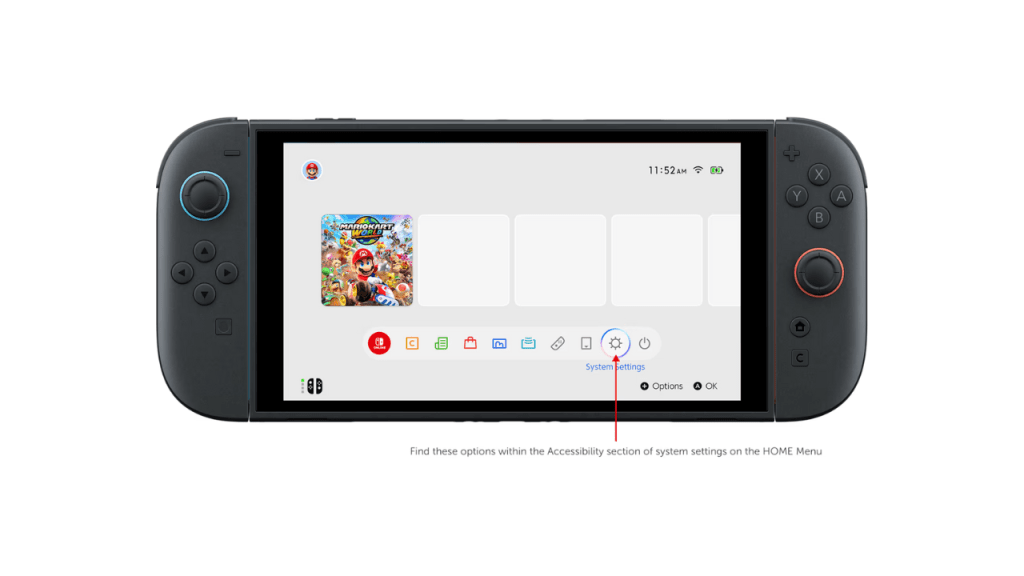
Nintendo is finally catching up to the rest of the industry in accessibility—but let’s not pretend they’ve sprinted to the finish line. The Switch 2 introduces a few meaningful improvements, but we’re still talking baby steps, not breakthroughs.
Button Remapping: Progress with a Caveat
Yes, button remapping is available per game, and you can save up to five individual control profiles per controller—which is great for players who need specific configurations due to physical disabilities, neurodivergence, or even just preference. Better still, Nintendo added Quick Settings access, letting you switch profiles by holding the Home button. That’s a win.
But the system still lacks a universal controller profile that applies across all titles by default.
In plain terms? If you use a Pro Controller and rely on a custom layout, you’ll need to remap it every time you start a new game. That’s not just tedious—it’s an unnecessary barrier. For players who need specific button setups for accessibility reasons, it’s especially frustrating.
There’s no good reason this can’t be addressed with a system update. Both Xbox and PlayStation offer global remapping, with the option to override on a per-game basis. Nintendo, we need that.
Visual & Auditory Support: Improvements, But Not Parity
The Switch 2 finally introduces a suite of visual and auditory accessibility tools, and they’re definitely steps in the right direction:
- Zoom Functionality: Easily activated via a double-tap of the Home button, with joystick or pinch-to-zoom support. Great for low-vision users.
- Color Modes: Grayscale, high contrast, and color inversion options are available at the system level.
- Text Customization: You can now choose from three text sizes and toggle bold text in the Home menu—finally.
- Mono Audio Support: Included for players with hearing differences.
- Menu Text-to-Speech: A new addition, with adjustable voice type, speed, and volume.
But there are still gaps. These settings don’t consistently carry over to third-party titles or even Nintendo’s own eShop. Many menus remain unvoiced, and individual games vary wildly in what features they support—even first-party ones. Early impressions are cautiously optimistic—but no one’s calling this a revolution yet.
Mental Health & Sensory Accessibility: Still Lagging
As someone with severe anxiety, I notice things like unskippable tutorials, cluttered menus, or surprise sound cues. These might seem minor, but they can make a game feel hostile or overwhelming. Unfortunately, the Switch 2 still doesn’t offer any sort of global “calm mode,” simplified UI, or low-stimulation audio setting—options that Xbox has been openly exploring for years.
Nintendo does let you disable rumble, dim the screen, and tweak system sounds—but that’s table stakes. We’re still waiting for Nintendo to treat sensory and cognitive accessibility with the same care it gives to, say, Joy-Con colors.
Room to Grow: What Nintendo Still Needs to Fix
- Add system-wide remapping profiles for controllers.
- Implement narrated menus across the entire OS—including the eShop.
- Offer universal font scaling, not just in a few menus.
- Build a centralized Accessibility menu instead of scattering features across submenus.
- Partner with accessibility experts—like Xbox did with the Adaptive Controller—to bake inclusion into their design process.
Final Thought
The Switch 2 makes a visible effort. It really does. And for many players, that’ll be enough. But where PlayStation and Xbox have made accessibility a core part of their platforms—baking it in from day one—Nintendo still seems to treat it like a side quest. A good side quest, sure, but not one you have to complete.
And that’s the missed opportunity. Nintendo has the hardware. The fanbase. The family-first philosophy. Now it just needs to act like accessibility isn’t an optional feature—it’s a standard.
There’s hope here. The tools are getting better. The feedback from the community is loud and clear.
Nintendo just needs to listen—and finally act like accessibility matters to everyone.
Pricing, Inflation, and the Tariff Trouble: How Bad Is It, Really?

Let’s talk about the elephant in the eShop.
The Nintendo Switch 2 is officially the most expensive console Nintendo has ever released. In Canada, you’re paying upwards of $700 CAD after tax just to get the base unit into your hands and Mario Kart. And the sticker shock doesn’t stop there—AAA games are now regularly priced at $80 USD, with some creeping even higher depending on edition, publisher, and launch window.
It stings, and you’re not imagining it. But here’s where it gets interesting.
Game Prices: Then vs. Now
Video games have followed a relatively stable pricing model for decades—but that’s not to say things haven’t shifted. The familiar $60 USD price point (roughly $70–$80 CAD depending on the year) held strong for almost two decades, from the Xbox 360/PS3 era all the way through to the early Switch and PS4 years.
But prior to that? Game prices were all over the map:
- In the early 1990s, SNES and Sega Genesis games frequently retailed for $50–70 USD—and some RPGs and niche titles went even higher.
- Adjusted for inflation, that’s the equivalent of $100–130 USD today. So yes, Phantasy Star IV costing $100 USD in 1995 was basically like paying $170 CAD in 2025.
In fact, according to historical data from game historians and economic analysts, game prices peaked in the early ‘90s and have been relatively flat or decreasing in real terms until the past few years. [Source: Ars Technica, Game Industry Analysis]
Why the Price Jump Now?
The current move from $70 to $80 USD (or $90–100CAD) didn’t come out of nowhere. Here’s why it happened:
- Rising Development Costs – Game development is wildly more expensive than it was even five years ago. Massive open-world games, ray tracing, cinematic voice acting, multi-year dev cycles—it all adds up.
- Console Generational Shift – With the PS5 and Xbox Series X/S in 2020, major publishers like Sony and 2K set a new standard at $70 USD. Microsoft followed in 2023. Nintendo’s now catching up with titles like Mario Kart World.
- Long-Term Price Stability – Holding at $60 for over 17 years means game prices didn’t keep up with inflation, and now the industry’s doing a hard recalibration. [Source: Axios, IGN]
So while it feels sudden, it’s more of a correction than a gouge.
Tariffs, Trade, and the Global Price Squeeze
Let’s not forget the geopolitical elephant in the room.
U.S. tariffs on China-imported electronics—including gaming consoles—have surged up to 145% on some categories. Microsoft directly tied recent Xbox price hikes to these tariffs. Sony and Nintendo have shifted manufacturing out of China in response, moving to Vietnam and other regions. [Sources: AP, Kiplinger, Houston Chronicle]
Even though I’m Canadian, there’s no escaping the ripple effect. When the U.S. gets trade-punchy, global supply chains respond—and companies spread the cost across all regions. If Microsoft and Nintendo are paying more for parts, packaging, and shipping, consumers everywhere are going to feel it.
Is It Still “Worth It”?
Here’s the argument the industry makes—and, annoyingly, it’s not without merit.
- Games today often offer 50–200+ hours of content, with additional expansions, seasonal content, and post-launch patches.
- While prices have gone up, so has game longevity. That $80 title could deliver more value per hour than a $20 movie or a $60 streaming subscription.
- And many smaller titles (indies, AA games, retro collections) still hold the line at $30–50 CAD, offering more affordable alternatives within the same ecosystem.
My Take
Yes, I winced at paying $99 CAD for Nintendo’s Big Names, and $109 for some like Mario Kart World (get that bundle now, people!) . And yes, the Switch 2’s launch prices are higher than anything Nintendo’s pushed before. But in context? It’s not price gouging—it’s the industry catching up with itself.
Still sucks in the moment though. Tariffs and publisher greed don’t care about your wallet’s feelings.
Still, regardless of Nintendo’s contrary claims, I suspect tariffs and international manufacturing shifts are making things worse. While I’m not American, I have no doubt those rising U.S. trade costs are being “shared” globally, and companies are spreading the pain market-wide. Thanks, Tariff Boy.
Final Verdict: Glorious, Frustrating, Worth It
Do I regret buying it? Hellz no.
It’s sharp, slick, backwards compatible, and a genuine upgrade in every way that matters—except, tragically, the battery. It’s not perfect. In classic Nintendo fashion, they’ve given us brilliance with baffling limitations. But for all my complaints, I can’t put it down.
Whether you’re in it for indie gems, the Pokémon redemption tour, or just craving a faster handheld experience, the Switch 2 delivers. It just might need a power bank to go with it.
Consider supporting me through Tips or Patreon. Your support on Patreon or through tips makes a huge difference for us! By becoming a patron, you’re not just supporting the show—you’re joining our community. Patreon contributions help cover production costs, equipment upgrades, and even lets us spend more time researching and bringing you the quality content you love. Tips through Squarespace is another awesome way to show your appreciation and help us with day-to-day expenses.

 Pixels and cocoa
Leave a comment